
The gems of Southern Africa
Our focus is on the coloured gemstones of Southern Africa, a region whose geology yields an unusual range of them.
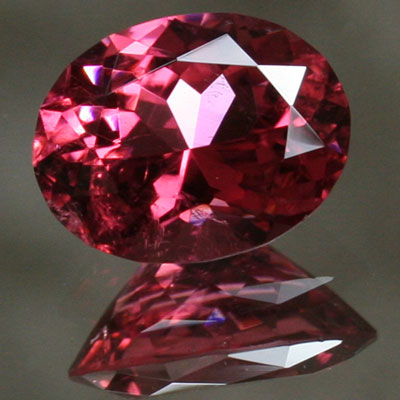
Tourmaline is not one mineral but a group of complex boron silicates, of which elbaite provides most gem material. Trace iron, manganese and copper account for a range of colour that no other gemstone matches: rubellite in pinks and reds, indicolite in blue, verdelite in green, and bi-colour and watermelon crystals that hold pink and green in a single stone. We source tourmaline from, among others, Namibia and Madagascar.
Demantoid is the grass-to-emerald-green variety of andradite garnet, coloured by chromium and iron. Its name alludes to a diamond-like lustre, and its dispersion of 0.057 exceeds that of diamond (0.044), so that fire shows through even its deepest greens. It is rare in fine sizes. The Ural Mountains gave the classic stones, prized for their fine “horsetail” inclusions, and Namibia is now an important source.

Aquamarine and emerald are both beryl. Iron gives aquamarine its blue, and at a hardness of 7.5 to 8 with usually exceptional clarity, it permits large stones of great transparency. Its name comes from the Latin for “water of the sea”. Emerald owes its green to chromium and vanadium, and Zambian stones are known for a cool, bluish green. Nearly all emeralds are clarity-enhanced, so we look closely at the extent of treatment as well as at colour.
We also work with sapphire in its many colours, much of it today from Madagascar, with garnets of several species, and with tourmalinated quartz, in which needles of black tourmaline are held in clear quartz. This is only a brief introduction to the wider universe of African gemstones and to the pieces we hold. The selection in the studio is broader than a single page can show, and we are glad to talk you through it.

Diamonds and the Kimberley Process
We do not hold diamonds in the studio. Every diamond is sourced to order, once we know what you are looking for, and we source it in accordance with the Kimberley Process Certification Scheme. The scheme grew out of a meeting of diamond-producing states in Kimberley, South Africa, in 2000, and came into force in 2003. Its aim is to keep “conflict diamonds”, rough stones used by rebel movements to finance war against legitimate governments, out of the legitimate trade. Participating countries trade rough diamonds only with one another, and every shipment is accompanied by a certificate. We regard the scheme as a foundation rather than a full answer, since it addresses rough diamonds and rebel-financed conflict specifically, and the wider questions of labour and environment remain with the dealer.